
HANS WESTGEEST

 |
Elgar’s Enigma Variations: |
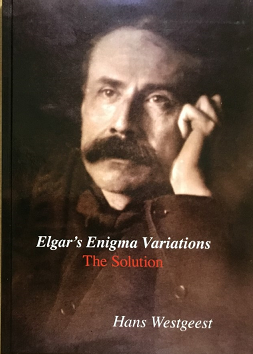
In 2007 my book Elgar’s Enigma Variations, The Solution was published, in which I presented a new solution to the enigma that Elgar incorporated in his Enigma Variations. Here is a brief summary of my theory. More context and elaborate arguments can be found in my book. For more details please see at the end of this article. 1. The enigma of the Enigma Variations, Elgar’s much loved variations for orchestra in which he musically portrayed a number of his friends, has given rise to speculation ever since its first performance in June 1899. The composer never was explicit about what the enigma entails and it is not even clear what the term “enigma” refers to: to the entire work, to the minor melody it opens with, or to just the first six measures of the opening? What do you do when you are supposed to write about a piece titled ‘Enigma’ if you have no idea what the enigma is actually about? You stay as close as possible to what the composer himself said about the piece. So when Charles A. Barry was asked to write programme notes for the premiere of the Enigma Variations in 1899, he quoted Elgar’s own words, giving the important message that ‘… through and over the whole set [of variations] another and larger theme “goes”, but is not played… So the principal Theme never appears….’ F.G. Edwards, editor of The Musical Times, did the same in his article on Elgar of October 1900. Starting with ‘Mr Elgar tells us that …,’ he mentions that it is possible to add another musical phrase, ‘which is quite familiar’, above the original theme that Elgar wrote. As correspondence shows, Edwards meticulously made all the changes to his text which Elgar and his wife Alice wanted after proofreading his article. Edwards even visited them a month before it was published to talk it over one more time. It is simply not possible that Elgar would have allowed any faulty information about his Enigma in Edward’s article. In his Elgar biography of 1905, Robert Buckley also claims that he is repeating Elgar’s own words. What he says about the work, confirms what Edwards mentioned about it: ‘The theme is a counterpoint on some well-known melody which is never heard.’ Their remarks reveal that one should look for a melody hidden in the work that can be combined with the theme of the work. In other words, to be more precise, the actual theme of the Enigma Variations must have been set as a countermelody to that mysterious melody that does not occur in the work, but at the same time is present throughout and that can be said to be both ‘larger’ than the actual Enigma theme and ‘quite familiar’. This undermines many of the solutions that have been suggested so far. A number of solutions is actually founded on a similarity between the minor theme at the beginning of the work and another specific melody, for example some notes they have in common (like the Rule, Britannia theory). Several other solutions do actually mention a specific melody that can be combined with the Enigma theme (like the hymn Now the day is over), but there are always one or more details that do not fit. Yet, it is highly unlikely that a competent composer like Edward Elgar would have allowed such flaws in his enigma. For more than a century after its premiere in June 1899, no-one has managed to find a melody that can convincingly be combined with the theme of the Enigma Variations. 2. However, in 2007 I published a solution that complies with all the criteria. I had been searching for a melody that Elgar had linked to the work in some way. Thus, I came across the private conversation he had with his friend Dora Penny in August 1904 about the Nimrod variation, which according to Elgar was not really a portrait, but ‘the story of something that happened’. The composer recounted to Dora Penny, a friend of the Elgars, how once, when he was depressed and wanted to stop composing, his friend and soulmate August Jaeger (= Nimrod of the ninth variation) lectured him sternly. Jaeger referred to Ludwig van Beethoven who, despite his great difficulties, had always persevered and composed more and more beautiful music. ‘And-that-is-what-you-must-do’, he said and sang the theme of the second movement of Beethoven’s Sonata Pathétique to him. According to Elgar himself, the Nimrod variation contains a musical reference to that melody: ‘Can’t you hear it at the beginning?’ he asked Dora Penny, ‘Only a hint, not a quotation.’ However, the chance that somebody would notice a link with Beethoven’s melody when listening to it without receiving any indication beforehand, is in my opinion very unlikely. Nevertheless, there is a clear link between the themes of Nimrod and the Pathétique, albeit an indirect one. By examining the exact link between the two, I discovered that there is an ‘underlying’ theme that plays a key role in the work. Nimrod is built out of a four-note motif. This motif reflects the rhythmic and melodic pattern of Edward Elgar’s own name: short-short-long-long and high-low-high-low: 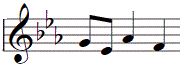 Music example 1: the ‘Elgar motif’ That Elgar sometimes was referring to himself with this four-note motive also becomes clear from the fact that he used it (in minor) to sign a letter he wrote to Dora Penny from a hotel in Leeds in 1901. Note that in the first variation, which he dedicated to his wife Alice, Elgar also refers to himself with a (rhythmically slightly different) four-note motif high-low-high-low. He used to whistle this to let Alice know he was home. The Nimrod melody starts with this ‘Elgar motif’. The rhythm short-short-long-long is followed by its reversion, long-long-short-short, finishing on the final note G (see music example 2). The rhythmic pattern of these two measures is then repeated twice more in the Nimrod melody.  Music example 2: the first measures of Nimrod However, unlike the Pathétique theme, this melody is written in ¾ time and therefore does not fit as a counterpoint to Beethoven’s theme. But if we give it the same time signature by adding a crotchet rest at the beginning of each bar, we see something remarkable: a melodic phrase emerges that combines perfectly as a countermelody to the beginning of the Beethoven theme. I call this new melody that plays a key role in the work, the ‘Elgar theme’. 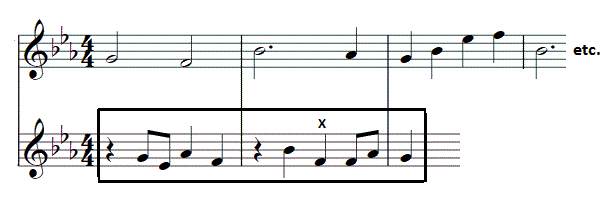 Music example 3: the ‘Elgar theme’ and above it the beginning of the theme from `Beethoven’s Pathétique (transposed to E-flat and notated in double note values) That the Elgar theme is written as a countermelody to the Beethoven theme becomes apparent from the second F in the ‘Elgar theme’ (marked with a cross in music example 3) which is actually a strange note since, based on the minor opening theme of the work, one would expect a G here. As the note is an F, it fits perfectly in the chord Beethoven uses there. Another possible clue is, for example, the tempo Elgar initially had in mind for Nimrod (and the opening theme). Nowadays the variation is played very slowly. Elgar himself already did that in his recording of 1926 with the Royal Albert Hall Orchestra: the tempo there is  = ca. 40. However, what is remarkable is that, according to the autograph of 1899, the composer originally had a considerably faster tempo in mind: ‘Moderato = 66’ (and for the opening theme: ‘Andante = 63’). Is it a coincidence that, when it is played in this original tempo, two crotchets of the ‘Elgar theme’ are perfectly in time with one minim of Beethoven’s theme in music example 3 when the latter is played Adagio cantabile, as prescribed by Beethoven? = ca. 40. However, what is remarkable is that, according to the autograph of 1899, the composer originally had a considerably faster tempo in mind: ‘Moderato = 66’ (and for the opening theme: ‘Andante = 63’). Is it a coincidence that, when it is played in this original tempo, two crotchets of the ‘Elgar theme’ are perfectly in time with one minim of Beethoven’s theme in music example 3 when the latter is played Adagio cantabile, as prescribed by Beethoven? 3. If we then take a closer look at the combination of the Elgar theme and the Beethoven theme, we see that the Elgar theme, although it contains more notes, does roughly have the same contours as the Beethoven melody. It turns out that the Elgar theme contains all the notes from the beginning of the Pathétique melody, moreover, that they appear in exactly the same order. We also ascertain that each of its notes follows the identical note in the Pathétique theme: the G of the Beethoven melody is followed by a G in the ‘Elgar theme’, Elgar’s F comes after that of Beethoven, etc. As follows:  Music example 4: the opening notes of the Beethoven theme are repeated in the ‘Elgar theme’ The musical symbolism of this is obvious: Elgar, symbolised by the Elgar theme, follows the example of Beethoven, represented by the theme from the Pathétique. He does the same as Beethoven, following him, as it were, closely. Thus, Elgar musically portrayed what Jaeger told him to. This turns out to be the central idea of the whole composition. With the short Elgar theme we have found the true main melody of the Enigma Variations. This melody appears throughout the work and in a variety of ways. As the separate notes from the beginning of the Pathétique melody are thus hidden in it, one could say that Beethoven’s theme is present throughout the entire work without it ever being played: ‘… through and over the whole set another and larger theme “goes”, but is not played…’. The Beethoven melody is the mysterious ‘principal Theme’ that lies hidden in the work and has the above characteristics that Elgar himself mentioned. It is ‘larger’ than the Elgar theme and it may well be called a ‘well-known melody’. So in actual fact Nimrod is not a variation on the minor theme from the opening, as one would expect, but an adapted version of the Elgar theme. The opening theme is already a variation on the underlying ‘Elgar theme’: while maintaining the rests, the theme was set in a minor key and extended. Rather unusually, Elgar at first just wanted to call the work ‘Variations’ or ‘Variations for Orchestra’ without alluding to a ‘theme’ in the title. Maybe he did not want to suggest too explicitly, as is common in other works in the genre “theme and variations”, that the opening melody was the actual theme of the work. Actually the ‘Elgar theme’ is the main melody. The variations that, each with their own character, portray friends of Elgar, are based on the opening melody and thus, indirectly, on the ‘Elgar theme’ too. Thus the main melody of the final movement is based on the ‘Elgar theme’ as well (the rhythm of its second half: long-long-short-short-short). In this Finale Elgar expressed the strength and confidence he felt by taking Beethoven as an example. This theory does not connect a trivial riddle with the work, but it demonstrates that in his Enigma Variations Elgar expressed as a ‘dark saying’ a thought that was meaningful and very important to him when he started the composition. Like some of his other works and those of his contemporaries Richard Strauss and Gustav Mahler, the Enigma Variations are really about the artist himself. As we know, in October 1898 Elgar was very dispirited for a while and he remained so until he got a new idea and enthusiastically started writing the variations. The minor melody with which the work starts, musically expresses the sadness and loneliness of the artist, as Elgar himself said later. The energetic Finale very successfully expresses the regained strength and confidence of the artist who has taken Beethoven as an example. Thus, the overall setup of the work is reminiscent of the progression ‘from darkness to light’ we know from some of Beethoven’s works. Elgar’s beloved friend and soulmate August Jaeger often encouraged him in difficult times and frequently gave valuable advice on his creative work. It was not without reason that he, in his passionate support, alluded to Beethoven and his art. All through his life Elgar had great respect for this musical genius whose orchestral scores he had already been studying from an early age. Jaeger himself was also given a place of honour in the work. Nimrod is the emotional climax placed in the centre of the work. In the Finale Elgar only quotes two variations: the first which he had dedicated to his wife Alice and the ninth, Nimrod. It was a token of appreciation for all the love, support and help he received from both of them. As Elgar himself put it years later, they were “two great influences on the life and art of the composer”. Hans Westgeest Hans Westgeest, Elgar’s Enigma Variations. The Solution. Corbulo Press, Leidschendam-Voorburg, 2007. Hardcover € 18,95 (ISBN 978-90-79291-01-4), paperback € 13,50 (ISBN 978-90-79291-03-8). Also available in Dutch. To order the book please send an email to the author (hans.westgeest@gmail.com).
|